Your funnel says most people who open the pricing page never sign up.
So you do what every team does. You open the replays, watch a few people scroll up and down, and guess. Maybe the price is too high. Maybe the plans are confusing. Maybe the button is below the fold. You pick a guess, redesign the page, wait two weeks for enough traffic, and look at the funnel again.
If the number moved, you still don't know why. If it didn't, you're back to guessing.
A better dashboard won't fix this. Behaviour data can only show you so much.
What behaviour data can't show
Analytics is very good at one thing: showing you where people stop. Every click, every page, every drop-off is recorded. Heatmaps show where attention goes. Session replays show the hesitation, the scroll back up, the cursor hovering over a button that never gets clicked.
But all of it is the outside of a decision. The reason someone left is on the inside:
- They couldn't tell whether the plan included the one thing they needed.
- They wanted to check with someone before paying.
- They were just comparing, and will come back next week.
- They didn't trust a product they had never heard of with their data.
Each of these looks exactly the same in a replay: someone reads the pricing page and leaves. Each needs a completely different fix. One needs a clearer table, one needs a way to share the page, one needs nothing at all, and one needs a security page. Guess wrong and you spend a sprint fixing a problem nobody had.
The reason someone left exists for a few seconds, in their head. Then they close the tab and it's gone.
The usual ways of asking miss the moment
Teams know they should ask. The trouble is when and who they ask.
User interviews reach the people who stayed. The visitor who left the pricing page isn't on your calendar next Tuesday. And the people who are on it are remembering a decision from weeks ago, which means they are explaining it, not reporting it.
The generic survey asks everyone, at a random time, about everything. "How was your experience today?" shows up after three seconds on the homepage, or on the way out, to someone who hasn't done anything yet. The few who answer are the very happy and the very annoyed. The middle, where most of your conversions are lost, closes the popup.
Both have the same flaw. They ask about the experience in general, when the useful answer is about one specific moment.
Ask at the moment, about the moment
So ask the person who is stuck, while they are stuck, about the thing they are stuck on.
Not "How was your experience?" but, to someone who has opened the pricing page twice and is about to leave: "What's stopping you from picking a plan?" Not a ten-question survey, but one question with a few likely answers and room to type their own.
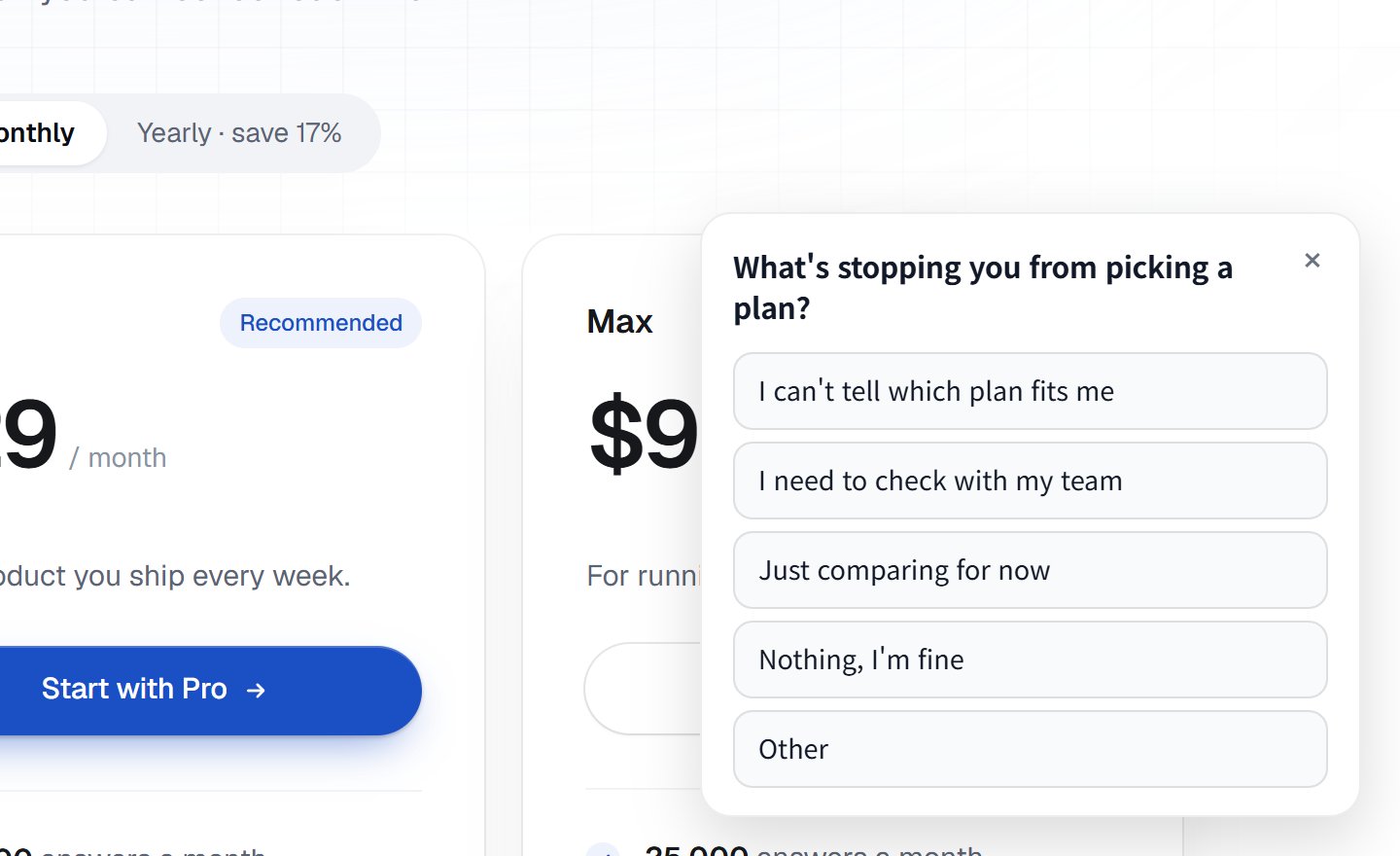
Asking this way changes a few things.
- The answers get specific. Someone who was confused by the plans a few seconds ago can tell you which part. A month later, they can only tell you it was "a bit confusing".
- You hear from the people you lost. Not the ones who made it to an interview, but the ones who were about to leave.
- The answer points at a fix. "I couldn't tell if it works with my setup" tells you what to change. A 3 out of 5 doesn't.
How to ask without being annoying
The fair objection is that popups are annoying. Most are, because they're about the company: rate us, subscribe, tell us how we did. A question that shows up when you're stuck and asks what's in your way is about the visitor's problem. It reads less like an interruption and more like someone noticed.
That only holds if you're strict about it. These are the rules we follow:
- One question. If you need ten, you need an interview, not a question.
- Only at a real moment: a page opened twice, a form left halfway, a long pause before leaving. Never in the first few seconds on a page.
- Never while someone is typing.
- At most one question per visit, and at least a week apart for the same person. If someone closes the question twice in a row without answering, don't ask them again for a month.
- Always include a "nothing, I'm fine" answer. If almost everyone picks it (we use 80% of at least 30 answers), stop asking. The moment wasn't a problem.
- Wait for enough answers, around 30, before you believe a pattern. Then split the people who answered into two halves and check the pattern shows up in both. If it only comes from one side, it may be a few loud voices, not a real problem.
The last two matter more than they look. A question that keeps running after it has found nothing is just noise. And a pattern from eight answers is an anecdote.
You still need analytics
None of this replaces your funnel. Analytics is how you find the moment worth asking about. It's the "where". It just can't be the "why", and pretending it can is how teams end up redesigning pages based on a hunch and a replay.
The next time a number drops and the team gathers to guess, try something else first. Find the moment it drops, and ask the people standing in it.
Ask your real visitors why they got stuck
Usercase shows one short question at the moment it happens. Virtual users let you rehearse before they arrive.
Get started free